
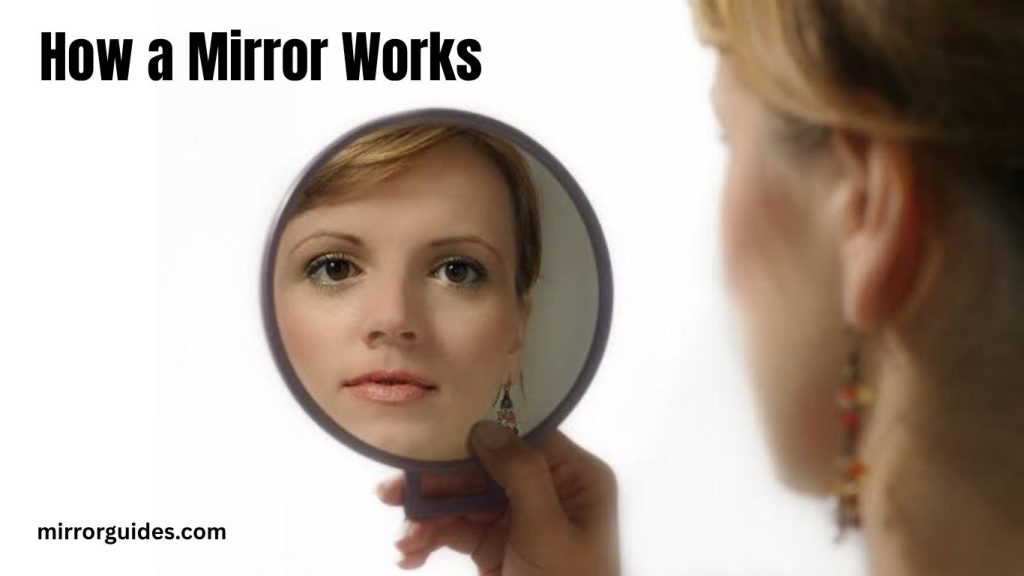
At its core, a mirror works by reflecting light waves off a smooth surface, creating a visual replica of the world in front of it. By using a process called specular reflection, mirrors allow us to see ourselves with clarity and precision every single day.
Have you ever stood in front of a bathroom vanity and wondered, “How does this thing actually work?” We use them to check our hair, apply makeup, or practice a big speech. Yet, most of us rarely stop to think about the fascinating physics happening right in front of our faces. Understanding how a mirror works is like pulling back the curtain on a magic trick—except the magic is pure, undeniable science.
To really get to the bottom of this, we have to talk about light. Light travels in straight lines until it hits something. When it hits a rough surface, it scatters in all directions. But when it hits a mirror, something special happens. The light bounces off in a perfectly organized way, sending an exact copy of the visual information back to your eyes. It is this precise “bouncing” that allows you to see yourself as you are.
Key Takeaways
- The Role of Light: Mirrors do not create images; they simply bounce light rays back to your eyes, which your brain interprets as a reflection.
- Specular vs. Diffuse Reflection: Unlike a wall that scatters light, a mirror creates specular reflection, which maintains the direction and clarity of light rays.
- The Silver Lining: Most modern mirrors are made using a thin layer of silver or aluminum deposited on glass to create a highly reflective surface.
- Virtual Images: The image you see is technically “virtual” because it appears to be behind the glass, even though the light is actually bouncing off the front.
- The Flip Factor: Mirrors swap left and right, which is why your reflection appears to be looking at you from the opposite side.
📑 Table of Contents
The Physics of Light and Reflection
The secret behind any mirror lies in the law of reflection. This law states that when a ray of light hits a flat surface, the angle at which it hits (the angle of incidence) is exactly the same as the angle at which it bounces off (the angle of reflection). Imagine throwing a bouncy ball against a flat floor. If you throw it straight down, it comes straight back up. If you throw it at an angle, it bounces away at the same angle on the other side.
Specular Reflection Explained
There are two main types of reflection: diffuse and specular. Diffuse reflection happens when light hits a rough surface, like a piece of paper or a painted wall. The light scatters, which is why you cannot see a clear “picture” of yourself in your living room wall. A mirror, however, uses specular reflection. Because the surface is incredibly smooth and coated with a reflective material, the light rays stay in their original order. This orderly return of light is what your brain processes as a crisp, clear image.
What Exactly Is a Mirror Made Of?
If you have ever been curious about the materials involved, learning about what is a mirror made of is quite enlightening. In the old days, people used polished bronze or stone. Today, we use a much more efficient process. A modern mirror is essentially a piece of glass with a thin, metallic coating applied to the back.
The Reflective Coating
The glass itself is just a transparent protective layer. The real work is done by a very thin film of metal—usually silver or aluminum—sprayed onto the back of the glass. This layer is so thin that it only accounts for a tiny fraction of the mirror’s total weight. This metallic layer is what captures the light and prevents it from passing through. If you are interested in the manufacturing side, you might also find it interesting to learn how is mirror made in modern factories.
Why Do Mirrors Reverse Left and Right?
One of the most confusing things about mirrors is why they swap left and right but not up and down. People often say mirrors are “left-right reversers,” but that is not strictly true. A mirror actually reverses depth. Think about it: if you stand in front of a mirror and point your finger, your reflection points right back at you. If you point to your left, the reflection points to what looks like its right. However, the mirror is just showing you exactly what is in front of it. Because you are facing the mirror, the reflection is also “facing” you, which makes your left side appear on its right side.
The Concept of a Virtual Image
The image you see in the mirror is called a “virtual image.” This is a fancy way of saying that the image does not actually exist where it looks like it does. If you walk behind a mirror, you will not find a “room” full of light. You will only find a wall. The light rays are not physically converging behind the glass; your brain just assumes they are because it is used to light traveling in straight lines. It assumes that if the light reached your eyes from a certain direction, the object must be located in that path.
Practical Tips for Using Mirrors in Your Home
Since we know now that mirrors are essentially tools for manipulating light, we can use them to our advantage in interior design. Placing a mirror opposite a window can make a small room look twice as bright by reflecting natural sunlight deeper into the space. If you are decorating, you might want to consider how high to hang a mirror to make sure the light hits it at the best possible angle. A mirror hung too low or too high might just reflect the ceiling or the floor, missing out on that beautiful light-bouncing potential.
The Cultural and Practical Legacy
Mirrors have been part of human history for thousands of years. They have transitioned from sacred objects used in ancient rituals to essential household tools. While we often think of them in terms of vanity, they are vital in science, medicine, and engineering. Telescopes, for example, use massive curved mirrors to collect light from distant stars. Without our understanding of how light reflects off a silver surface, our view of the universe would be significantly smaller.
Whether you are dealing with a standard bathroom mirror or a complex scientific instrument, the principle remains the same. You are witnessing the beautiful, predictable path of photons hitting a surface and returning to their origin. It is a simple concept that has shaped how we view ourselves and the world around us.
In conclusion, the next time you glance in the mirror, remember that you are looking at a masterclass in physics. By using a smooth glass surface and a metallic backing, we have managed to create a device that captures reality and sends it right back to us. It is this balance of chemistry and light physics that makes the humble mirror one of the most important inventions in human history.
Frequently Asked Questions
What causes a reflection to look distorted?
Distortion occurs when the surface of the mirror is not perfectly flat, causing light to bounce off at slightly different angles. This is common in cheap or thin mirrors that warp easily.
Why do mirrors turn yellow over time?
The silvering on the back of a mirror can oxidize over many years when exposed to moisture or air, leading to a yellowish or dark tarnish often seen on antique mirrors.
Is a “two-way” mirror different from a regular one?
Yes, a two-way mirror is only partially reflective, allowing some light to pass through while reflecting the rest. This is how they create the illusion of a solid mirror on one side and a window on the other.
How do animals react to mirrors?
Most animals do not recognize their reflection as themselves, often reacting to the reflection as if it were another animal. Only a few species, like dolphins and elephants, have passed the “mirror test” for self-awareness.
Can you make a mirror at home?
While you can create a simple reflective surface using polished metal, professional mirror making requires complex chemical processes to apply a thin, even layer of silver safely.
Does the color of the glass affect the reflection?
Yes, standard green-tinted glass can slightly alter the colors of a reflection, which is why high-end makeup or art mirrors often use “extra-clear” or low-iron glass for better color accuracy.
Pingback: How to Clean a Mirror Without Streaks for a Perfect Shine - Mirror Guides
Pingback: 5 Best Home Workout Mirrors for an Elite Fitness Experience at Home - Mirror Guides