
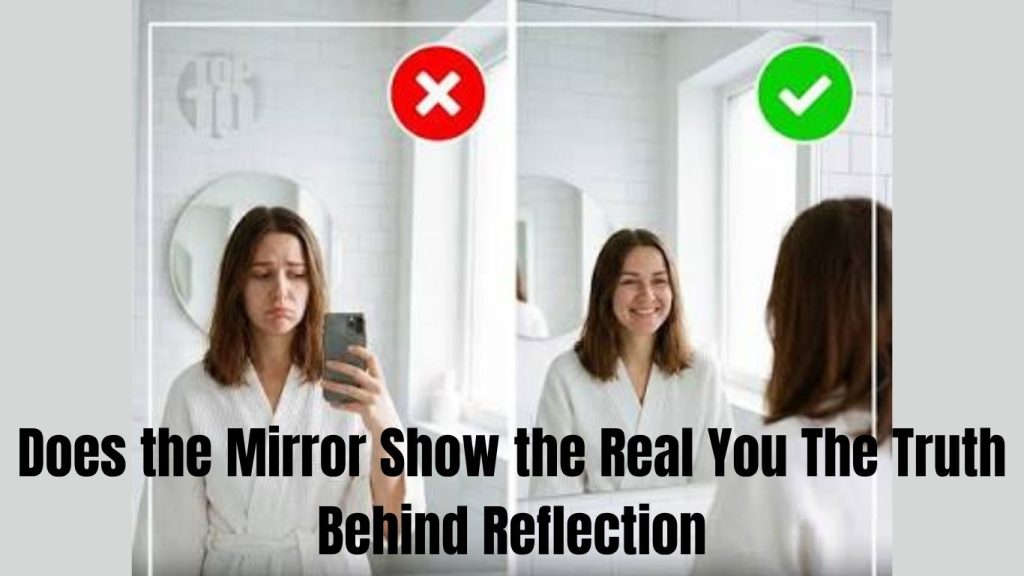
Do you really know what you look like? While we stare at our reflection daily, the image is often a filtered version of reality shaped by optics, psychology, and personal bias. This article dives into the truth behind your reflection and why the mirror doesn’t always show the real you.
Every morning, you stand in front of the bathroom glass to brush your teeth or fix your hair. You look at your face and think you know exactly what is looking back. But have you ever stopped to wonder, does the mirror show the real you? It is a question that hits at the heart of how we perceive ourselves and the world around us. While we rely on mirrors for grooming and style, the image they present is far from an objective portrait of reality.
The truth is, mirrors are masters of illusion. Between the way light bounces off surfaces and the way our brains process self-images, what you see is a complex mix of physics and psychology. If you have ever been surprised by a photo of yourself, you have experienced this disconnect. Let’s look at why your reflection is more of a ghost than a twin.
Key Takeaways
- Optical Reversal: Mirrors flip images horizontally, meaning you see a reversed version of your face that others do not see.
- The Mere Exposure Effect: You prefer your reflected image because it is what you see most often, even if it is technically backward.
- Psychological Perception: Your mood, stress, and self-esteem significantly alter how you interpret your own facial features.
- The “Video” Reality: Photographs and videos provide a more accurate representation of how the world perceives your appearance.
- Technical Limitations: Lighting, distance, and the quality of the glass change the clarity and accuracy of the reflected image.
📑 Table of Contents
The Physics of Your Reflection
To understand the mirror, we first have to understand the hardware. If you are curious about the technical side, it is fascinating to learn how is a mirror made in modern factories. Most mirrors are made by coating a sheet of glass with a thin layer of silver or aluminum. This creates a surface that reflects light perfectly, but it does not reproduce your face with 100% accuracy.
The Horizontal Flip
The biggest issue with a mirror is that it reverses the image horizontally. If you raise your right hand, your reflection raises its “left” hand. Because human faces are not perfectly symmetrical, this flip matters. Your left eye might be slightly lower than your right, or your nose might have a slight tilt. In a mirror, these features are swapped, creating a version of you that looks “correct” to you but “wrong” to everyone else.
Lighting and Depth
Light plays a massive role in what you see. A mirror in a dimly lit hallway will show a much different version of you than one in bright sunlight. Mirrors also lack the depth perception of the human eye. They flatten features and compress space, which can make you appear slightly different in size or proportion depending on how far you stand from the glass.
Psychological Bias and the Mere Exposure Effect
Aside from physics, your brain has a major role in how you view your reflection. Have you ever wondered why you might like your mirror image more than a candid photo? This is known as the “Mere Exposure Effect.” Because you spend years looking at your reversed reflection, you have become accustomed to that specific image. Your brain identifies that “flipped” face as “you.”
Why Photographs Feel Weird
When you see a photograph, the image is not flipped. It is the way your friends see you. Because your brain is not used to seeing your face in this non-reversed way, it often detects tiny imperfections or “wrongness.” You aren’t actually looking worse in photos; you are just looking at a version of yourself that your brain doesn’t recognize as familiar.
The Impact of Mood
Your self-esteem and current mood act like a filter over the mirror. When you feel happy or confident, you tend to focus on the features you like. When you are stressed or tired, the mirror seems to highlight every blemish or shadow. Does the mirror show the real you? It shows the version of you that your current state of mind allows you to see.
The Evolution of Reflection
Humans have been obsessed with their own images for millennia. If you want to dive deeper into the history of these objects, checking out who invented the mirror reveals just how long we have been trying to capture our likeness. Early humans used polished volcanic glass or still pools of water to see themselves.
Mirroring as a Social Tool
Mirrors are not just for vanity; they are tools for social survival. We use them to ensure we fit in, look clean, and express the identity we want to project to the world. Because we use them so frequently, we often forget that they are essentially just a piece of technology. Whether you are learning what is a mirror exactly or simply deciding where to hang one, it helps to remember that the object is just a reflection of light—not a reflection of your worth.
Can We Ever See the “Real” You?
If the mirror flips the image, and photos can distort angles, is there a way to see the real you? Some experts suggest that a “true mirror”—a non-reversing mirror made of two mirrors joined at a 90-degree angle—is the only way to see yourself as others do. When you look into this, the image is not reversed, and for many, it is a startling experience.
Practice Acceptance
Instead of chasing the “real” image, try to accept that your identity is dynamic. You are not a static reflection in a piece of glass. You are a living, breathing person who looks different in every light, at every angle, and in every emotion. The “real” you is not a static image—it is the person who lives behind the eyes looking at the mirror.
Conclusion
So, does the mirror show the real you? The answer is both yes and no. It shows your physical features, but it lacks the context of movement, personality, and the perspective of others. It gives you a version that is reversed and filtered by your own psychological biases. Understanding that the mirror is not a perfect judge of your appearance can be incredibly freeing. Next time you look in the mirror, remember that you are seeing a unique, fluid, and complex person—not just the glass-covered image staring back at you.
Frequently Asked Questions
Does the mirror show the real you?
The mirror shows a horizontally flipped version of your appearance. Because human faces are not perfectly symmetrical, this is not exactly how you appear to others in real life.
Why do I look better in the mirror than in photos?
You prefer your mirror reflection because you are accustomed to seeing it every day. Your brain identifies the reversed image as “normal,” so when you see a non-reversed photo, it feels unfamiliar.
Are mirrors completely objective?
No, mirrors are affected by the quality of the glass, the lighting in the room, and the distance between you and the surface. These factors can distort how your features appear.
How can I see myself as others see me?
You can use a non-reversing mirror, which uses two mirrors at a 90-degree angle to display your image without the horizontal flip. This provides a perspective closer to what other people see when they look at you.
Does mood influence how I view my reflection?
Yes, psychological studies show that self-esteem and mood significantly impact how we perceive our own facial features. When you feel negative, you are more likely to fixate on perceived flaws in the reflection.
Is the reflection in a mirror considered “real”?
The light reflecting off the mirror is physically real, but the image is a projection. It is a visual representation of you, but it lacks the depth, movement, and context that define your true identity.